OrionDrive: why I ended up writing my own cloud
Two posts that I promised to talk about backend. This time, I swear, here we are. 😄
The Context
For years, my files lived on Google Drive. Convenient, fast, zero maintenance… and zero control. My documents, my photos, my projects: all of it sitting on servers I don’t choose, under terms I don’t negotiate, with a quota that grows when I pay.
Getting off the GAFAM track isn’t just a stance for me. It’s deciding where my data lives, who can read it, and how much it costs. The answer came down to one word: at home. I have a server, it has 10 TB of storage. My limit is my disk — not a monthly subscription.
That left the software to pick. And that’s where I went shopping.
The Problem: nothing fit
Nextcloud
First stop, the obvious one. Huge ecosystem, an app for absolutely everything… and that’s exactly the issue: it’s a catch-all. I wanted a drive, not an office suite with a calendar, a chat and a social network bolted on.
But the real wall was performance. I was capped at 50 MB/s on transfers, where every other solution I tested afterwards comfortably hit 100-110 MB/s. I spent hours fiddling with the PHP executor and OPcache to claw back a few percent. Even tuned to death, Nextcloud stays slow.
Cloudreve V3
Visually, a punch in the face — in a good way. Clean, modern interface, and real feature density. Performance kept up too, since it’s written in Go.
Except those weren’t my features. Plenty of things I’d never use, and none of the ones I actually needed.
ownCloud Infinite Scale
Go again, so the throughput was there. But the extension ecosystem is narrow, and too many functions were missing for my taste.
More importantly, oCIS is built as microservices. That’s perfectly defensible at company scale. For a personal cloud, it means a deployment that’s out of proportion and maintenance that matches. Too much complexity for a simple use case.
Seafile
The desktop client is genuinely excellent. Sync is solid and fast.
But on the feature side it’s deliberately minimal. It does one thing very well, and I wanted a bit more than that.
Back to square one
I went back to look at Cloudreve V4. On paper, very good. Except too many features had moved behind a paywall.
Here’s what I observed in my own usage — this isn’t a benchmark, just field notes:
| Solution | Language | Observed throughput | What blocked me |
|---|---|---|---|
| Nextcloud | PHP | ~50 MB/s | Slow even when tuned, catch-all |
| Cloudreve V3 | Go | ~100-110 MB/s | Not the features I was after |
| ownCloud Infinite Scale | Go | ~100-110 MB/s | Microservices = heavy deployment, limited extensions |
| Seafile | C / Python | ~100-110 MB/s | Too minimal |
| Cloudreve V4 | Go | — | Too many paid features |
At that point the picture was simple: either it’s fast but incomplete, or complete but slow, or good but paid.
So I wrote my own.
The Solution: OrionDrive
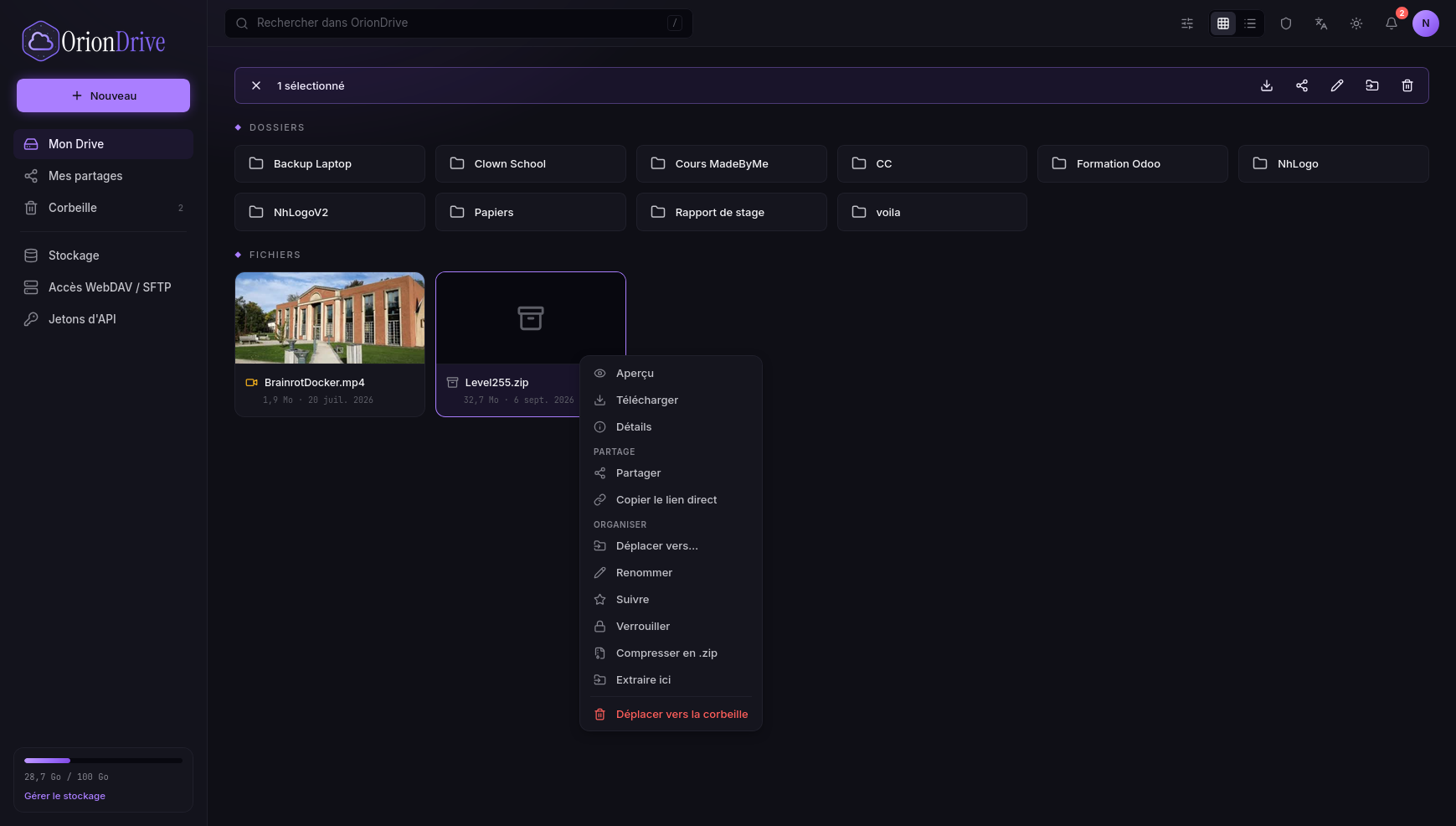
OrionDrive is a self-hosted drive that fits in a single binary. A Go backend that embeds the Vue 3 SPA directly — no web server to configure alongside, no PHP-FPM to tune, no microservice stack to orchestrate. You run the binary, you’re done.
What it does
- Files — explorer, resumable chunked upload, trash and restore, versioning, file locking, per-group quotas
- Storage — local disk, S3 or a remote node, with direct or presigned downloads and per-group speed limits. Optional AES-256-CTR encryption at rest
- Sharing — file and folder links with permission levels (view, edit, blind deposit), passwords, expiry and download limits
- Protocols — WebDAV and SFTP, each with dedicated credentials, plus personal access tokens for the API
- Preview and editing — images, video, audio, PDF, text, Markdown, ePub, an image editor, and collaborative Office editing over WOPI (OnlyOffice or Collabora)
- Archives — background compression and extraction (zip, tar, 7z)
- Administration — groups with granular permissions, per-group storage policies, SSO group to internal group mapping, scheduled maintenance
Under the hood
Go 1.26 with Gin and GORM, on SQLite, PostgreSQL or MySQL as you like — pure Go, so the binary stays static. Migrations with goose, CLI with cobra, OIDC through coreos/go-oidc, S3 with the AWS SDK v2, and optional Redis for a shared cache in multi-node setups.
On the frontend: Vue 3, Vite, TypeScript, Pinia, an installable PWA, light and dark themes, and full internationalisation in French and English.
A small nod along the way: the interface uses Orion, the design system I built, which also dresses this very site. Same oklch tokens, same violet. My drive and my portfolio are family.
The Weak Points
No project is perfect, and mine less than most — it’s young.
- Authentication is OIDC only. No local accounts, no password stored in the drive. It’s a deliberate choice, but it means you need an identity provider alongside. I have my own (OrionAuth); for anyone else that’s one more dependency to install.
- No native sync client. WebDAV and SFTP cover the essentials, and I wrote
kio-orionfor native KDE integration, but we’re far from the comfort of the Seafile client. - The ecosystem is me. No community, no extension marketplace. A bug means I don’t depend on anyone to fix it — but nobody will fix it for me either.
What About AI?
Like in my previous posts, I won’t lie: Claude Opus 5 helped me a lot in building this project.
But let’s be clear, this project was not vibe-coded. Every line committed and pushed was read, understood and thought through. The architecture, the layering, the storage choices, the permission model: all of that came out of my own head. AI speeds up the writing, it doesn’t decide for me.
That distinction matters, especially on a project that handles someone’s personal files.
My Take
OrionDrive does exactly what I asked of it: a fast drive, with the features I need, deployable in one command, and one that will never bill me a thing.
It’s licensed under MIT. Free, and it will stay that way.
My only limit today is the 10 TB on my server. Safe to say I have room.
The code lives here: git.nhsoul.fr/nhpro/orion-drive
Third post, and this time I kept my word on the backend! The next one will probably be about OrionAuth, because writing your own OIDC server is a whole other story… 🚀